..


GCSS Playing Rules for the 2010 Season

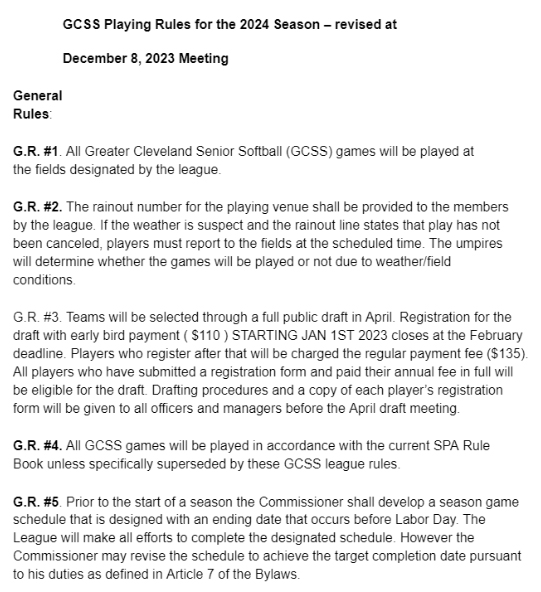
All ASA rules apply unless specifically superseded by these league rules.
*Indicates a rule change for 2008.

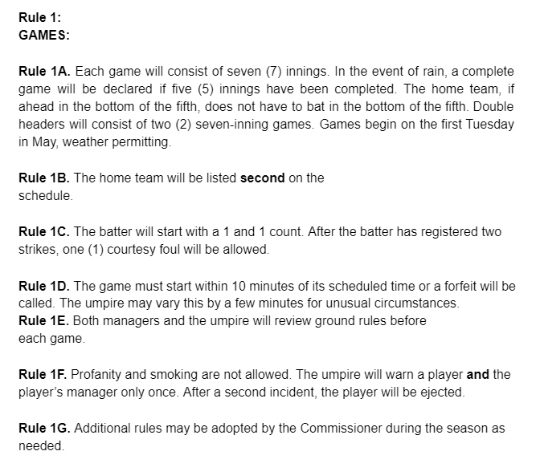
Rule 1: Each game will have 9 innings with a 1-1 count. Only 1 foul after 2 strikes will be allowed.

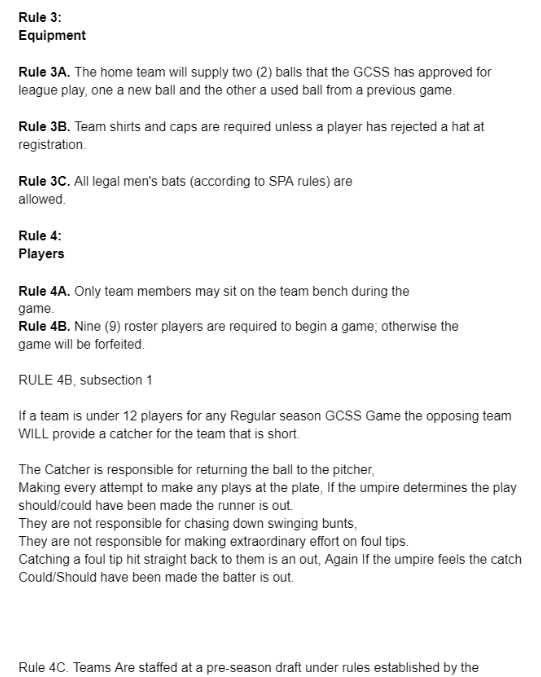
Rule 2: Eight (8) roster players are necessary to begin a game; otherwise it is a forfeit.

Rule 3: A game must be started within 10 minutes of its scheduled time.

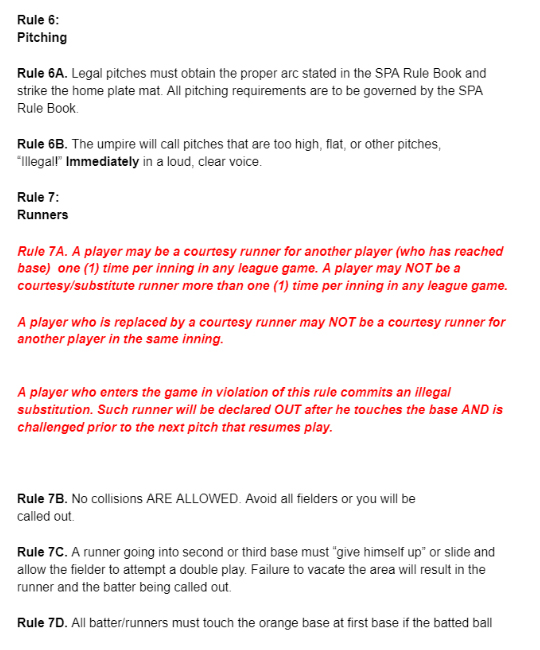
Rule 4: A substitute runner may only substitute run once per inning.

Rule 5: Team shirts and caps are required. – black or dark blue pants are PREFERRED.

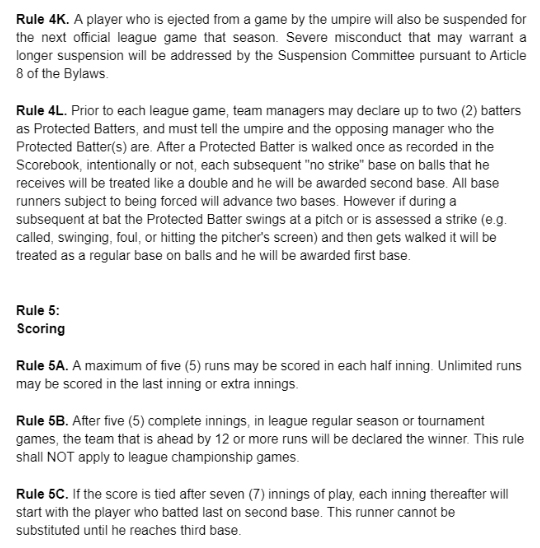
Rule 6: A maximum of 5 runs can be scored in each half inning; unlimited in last inning.

*Rule 7 ALL legal bats are allowed. The league will use a 375/44 core ball.

Rule 8: NO COLLISIONS are allowed – avoid all fielders or you will be called out.

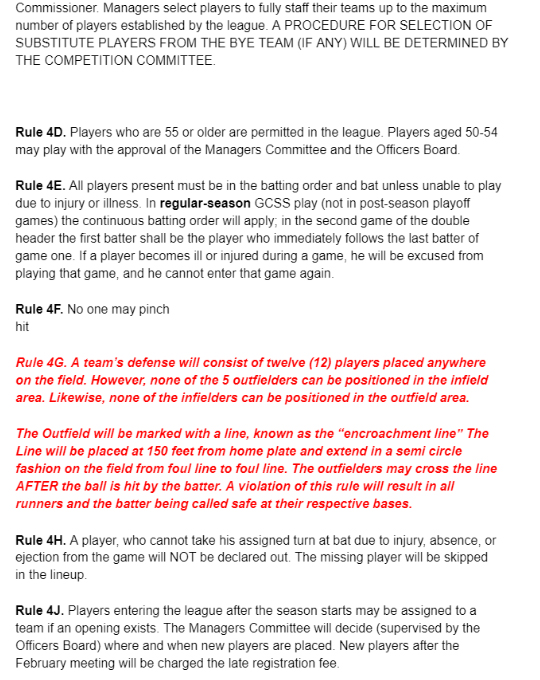
Rule 9: Players ages 55 and up are permitted in the league. Players ages 50-54 may be allowed with approval of the Governing Board.

Rule 10: Profanity and smoking are not allowed; the umpire will warn a player only once; a second incident will cause the player to be ejected from the game.

Rule 11: Each home team, will supply a game ball and a second ball from the team’s used balls marked with a “U” on it.

Rule 12: Both managers and the umpire will cover ground rules before each game.

*Rule 13: Each player must play at least 3 innings in the field in a 7-inning game or 4 innings in an 8 or 9-inning game; all players bat. Extra innings do not count.

Rule 14: An injured player may DH only if both managers agree.

Rule 15: Games ending in a tie will begin each extra half inning with a man on second. This man will be the batter that batted last in the previous inning. He cannot be substituted for with another runner until he reaches third base.

Rule 16: Unlimited substitution is allowed except within the same inning.

Rule 17: A team’s defense will consist of no more than 12 players

*Rule 18: All doubleheaders will be 8 innings, scheduled or rainout.

*Rule 19: The mercy run rule will be 15 or more runs ahead after 6 innings in an 8 or 9 inning game or 5 innings in a 7 inning game.

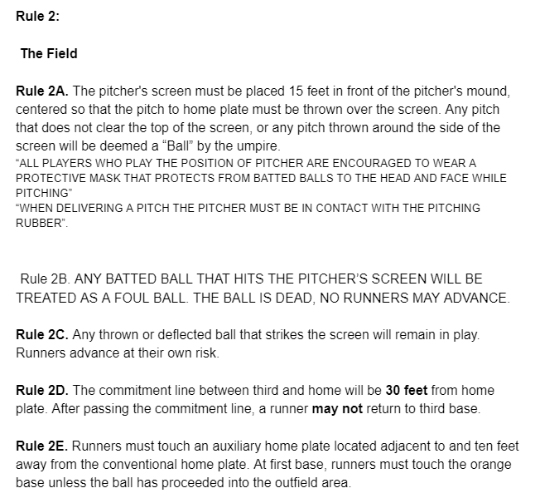
Rule 20: The commitment line between third and home will be 20 feet from home plate.

*Rule 21: All putouts at home must be made by touching the new, larger home plate.

Rule 22: A runner going into second base must vacate the area (give himself up) allowing the infielder to throw to first to attempt a double play. Failure to yield will result in the runner and the batter being called out.

Rule 23: Legal pitches will be 6 to 12 feet from the ground. Illegal or flat pitches will be called by the umpire at his discretion.

Rule 24: Substitutes for a team’s missing players (no more than 4) will bat last. These subs must be placed defensively at catcher, right field, right centerfield, and second base in that order. Teams may pick from the drafted list or pick any manager.

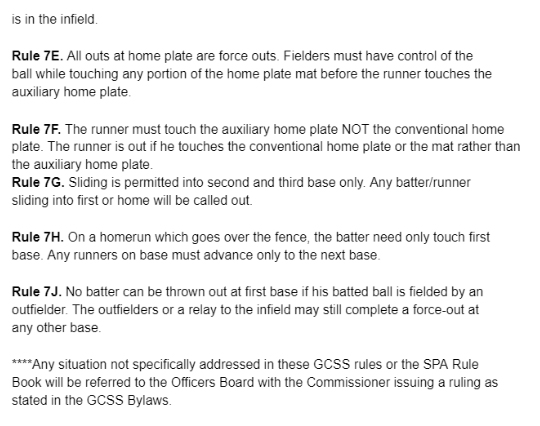
Rule 25: Players will be called out at first if they do not touch the orange base; at home, players must touch the auxiliary base, NOT home plate.

Rule 26: The HOME team will be designated by the schedule.

*Rule 27: Rules may be adopted by the Commissioner with the approval of the Governing Board during the season as needed.

Rule 28: Any player sliding into home or first base will be called out.

Rule 29: A batter/runner must touch the orange base at first if his batted ball in the infield results in an attempt to put him out at first base.

Rule 30: If a substitute runner is still on base when it becomes his turn to bat, the runner will be called out AND the substitute runner will bat next (which would be his normal turn at bat).

Rule 32: If a batter is walked, he will bat again, and the batting team will put a substitute runner on first base. If he is walked again, HE will go to first base.

Rule 33: When a batter is walked, intentionally or not, all runners will advance with the new runner taking first base.

Rule 34: The batter must only touch first base on any home run OVER the fence, and all base runners must advance only to the next base.

Rule 35: NO substitute runner may have a substitute runner run for him in the same inning.

*Rule 36: Only team members may sit on the team bench during the game.

*Rule 37: Each Manager (before the season starts) will select which 4 runners will be substituted for AND the four players from his team who will NOT be able to be SUB runners. The Commissioner will give this list to each Manager.

*Rule 38: The GCSS league will provide a screen for use by any pitcher who desires to use it. The first batted ball in any individual player’s AT BAT to hit the screen either on a bounce or line drive will result in a dead ball – the same as a “no pitch.” IF, in the same AT BAT, the batter hits the screen again with a batted ball, the batter will be declared out and the ball is dead with no advancement by any runner. Any ball THROWN or KICKED into The SCREEN will be IN PLAY and all runners may advance at their own risk.

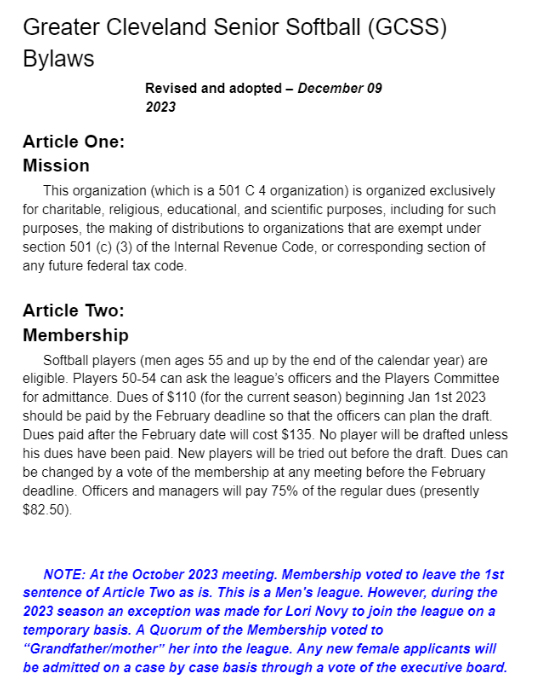
Greater Cleveland Senior Softball Bylaws

Article One: Mission
This league is established to provide for the enjoyment of its members through playing competitive softball and attending related social activities.

Article Two: Membership
Softball players (men ages 55 and up by the end of the season’s calendar year) are eligible to participate. Dues of $60 must be paid by February 15 of the upcoming season. Dues may be raised by a vote of the membership at any meeting before Feb. 15.

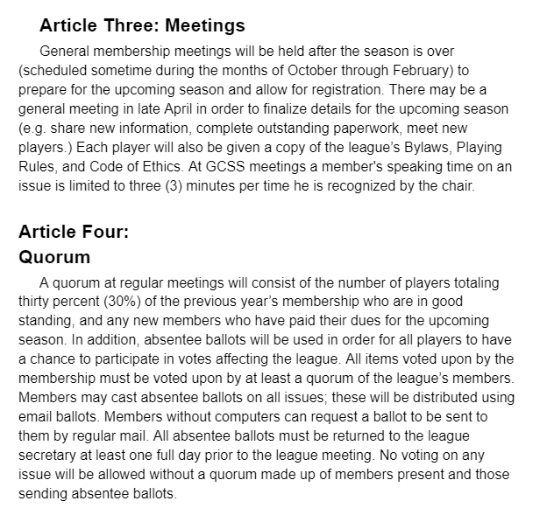
Article Three: Meetings
General Meetings (all players) will be held on the second Thursday of the month in the months of October, December, February, and April.

Article Four: Quorum
A quorum at regular meetings will constitute 25 members of the previous year’s membership who are in good standing. All items voted on by the membership must be voted upon by at least a quorum of the league’s members. If possible, members may cast absentee ballots on important issues. No voting on any issue will be allowed without a quorum being present at the regular membership meeting.

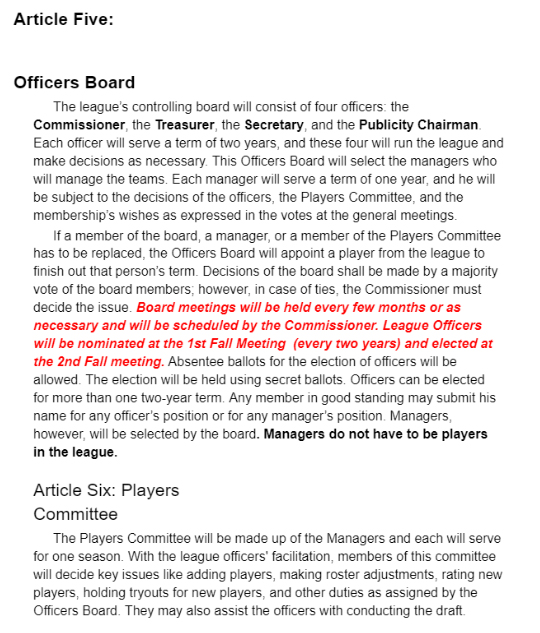
Article Five: Governing Board
The Governing Board shall consist of four officers: the Commissioner, the Treasurer, the Secretary, and the Umpire-in-Chief. Each officer will serve a term of two years. These officers will select the managers who will also serve on the board. The managers will serve a term of one year each. If a member of the board or a manager has to be replaced, the board will appoint a member of the league to finish out that officer’s or manager’s term. Decisions of the board shall be made by a majority vote of the board members. Regular Board meetings will be on the second Thursday in September, November, January, and March.

Article Six: Officers
Officers will be nominated by the previous season’s board for the coming two-year term. Candidates must submit their names to the board by/at the October regular meeting or Nov. 1. The board will nominate a slate of officers from those nominated who will be voted upon at the December meeting. Officers may be elected for more than one two-year term. Any member may submit his name for consideration for any officer’s position or for any manager’s position. Managers will be selected by the board.

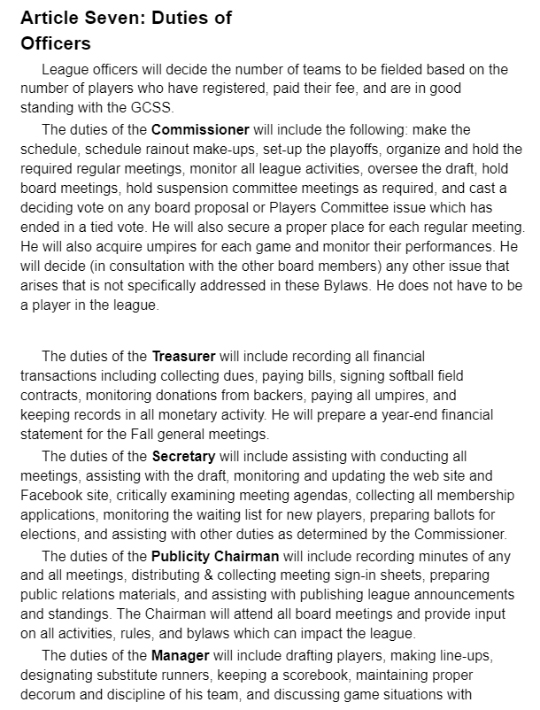
Article Seven: Duties of Officers
The duties of the Commissioner will include the following: make the schedule,
schedule rainouts, set-up the playoffs, organize and hold the required regular meetings, monitor all league activities, publish league announcements and standings, hold board meetings, hold rules committee and suspension committee meetings as required, and cast a deciding vote on any board proposal which has a ended in a tied vote.

The duties of the Treasurer will include recording all financial transactions including collecting members’ dues, paying bills, signing softball field contracts, collecting league backers’ donations, and keeping records of all monetary activities. He will also prepare a year-end financial statement.
The duties of the Secretary will include recording minutes of any and all meetings, preparing public relations materials, preparing ballots for voting, collecting all membership applications, and securing a proper place for each regular meeting. He will read the minutes from the last regular meeting at each regular meeting.

The duties of the Umpire-in-Chief will include acquiring and scheduling umpires for all games, training new and experienced umpires, and monitoring umpire performance. The Chief will attend all Governing Board meetings and provide input on all activities, rules, and bylaws which can impact the league’s umpires.

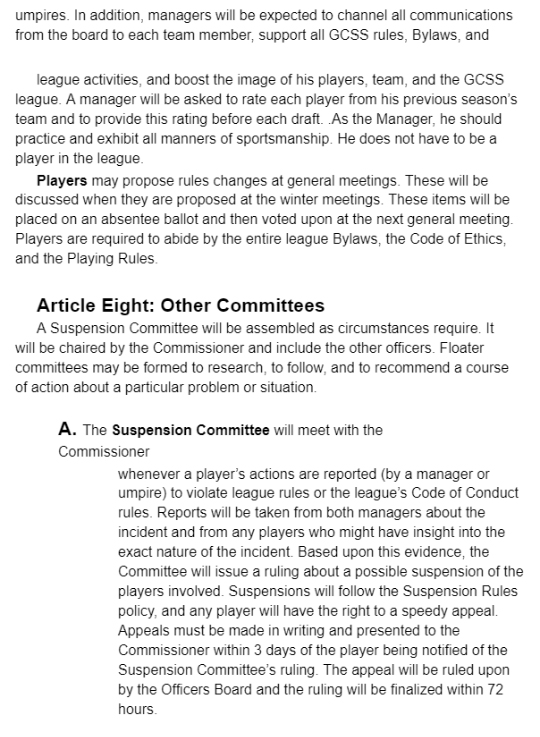
The duties of the Manager will include drafting players, making line-ups, designating substitute runners, keeping a scorebook, maintaining proper decorum and discipline of his team, and discussing game situations with umpires. In addition, managers will be expected to channel all communications from the board, support all GCSS rules, Bylaws, and league activities, and boost the image of his players, team, and the GCSS league.

Article Eight: Committees
Standing committees will include a Rules Committee and a Suspension Committee. Ad Hoc Committees may be formed by the governing board to research, to follow, and to recommend a course of action about a particular problem or situation.

A. The Rules Committee will meet after each season and before the October regular meeting to decide upon any rules changes necessary for the upcoming season. These will be presented to the membership at the October regular meeting and voted upon at the December regular meeting. Any player can submit a suggestion for a rules change to any of the committee members or the league officers. These suggestions will be discussed by the committee, and, if found to benefit the league, they will be submitted to the board for approval and implementation for the nest season.

B. The Suspension Committee will meet with the Commissioner whenever a player’s actions are reported by a manager to violate league rules or league Code of Conduct rules. Reports will be taken from both managers about the incident and from any players who might have insight into the exact nature of the incident. Based upon this evidence, the Committee will issue a ruling as to the possible suspension of the players involved. Suspensions will follow the Suspension Rules policy, and any player will have the right to a speedy appeal. Appeals must be made in writing and presented to the Commissioner within 3 days of the player being notified of the Committee’s ruling. The appeal will be heard and ruled upon by the governing board.

Article Nine: Amendments
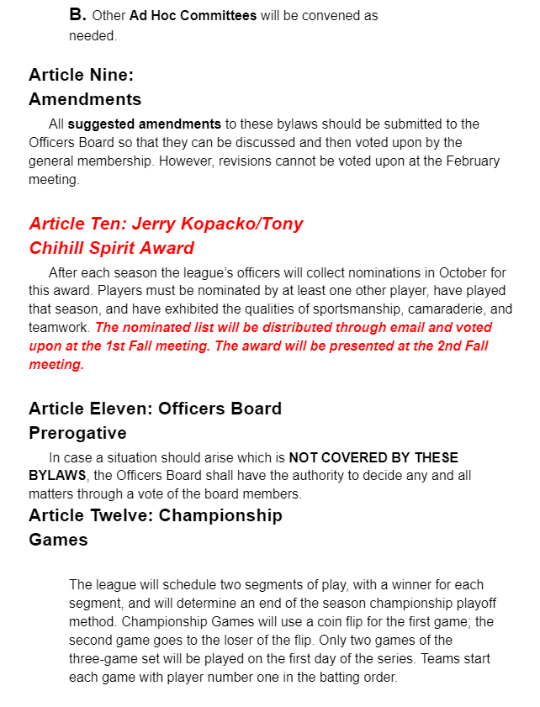
All suggested amendments to these bylaws must be submitted in writing to the Secretary who will duplicate them and disburse them to the Governing Board members. If any suggestion is worthy of having the membership vote on the issue, the suggestion will be duplicated and given to the general membership between the October general meeting and the December regular meeting so that it can be discussed and voted upon by the regular membership at the February regular meeting.

Article Ten: Dissolution
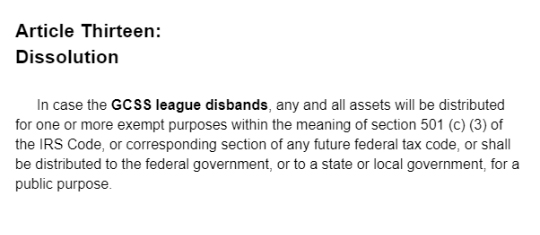
In case the GCSS league disbands, any and all remaining monies shall be equally distributed to all the league members in good standing. If a new entity is to be formed from a group of GCSS members after GCSS has decided to disband, then the present governing board may decide to forward all monies to the new group provided that the regular membership agrees with that decision at a last regular meeting of GCSS members.

Article Eleven: Governing Board Prerogative
In case a situation should arise which is NOT COVERED BY THESE BYLAWS, the Governing Board shall have the authority to decide any and all matters through a vote of the board members.


Please report any errors on this site to our WebMaster